
Hong Kong vs Singapore: Which Jurisdiction Is Better for Your Business?


When expanding internationally, one of the first decisions entrepreneurs face is Hong Kong vs Singapore. Both jurisdictions are consistently ranked among the world's leading business hubs, offering political stability, sophisticated financial systems, and straightforward company incorporation procedures.
However, while they share many similarities, they serve different business strategies. Choosing the right jurisdiction depends on your target markets, tax planning, banking needs, operational requirements, and long-term growth objectives.
In this guide, we compare Hong Kong vs Singapore across the factors that matter most to international businesses.
Hong Kong vs Singapore: Quick Comparison
Feature | Hong Kong | Singapore |
Corporate Tax | 8.25% on first HKD 2 million of assessable profits; 16.5% thereafter (subject to applicable rules) | 17% headline rate with various exemptions and incentive schemes |
Territorial Tax System | Yes | Primarily territorial with certain foreign income taxation rules and exemptions |
Foreign Ownership | 100% allowed | 100% allowed |
Minimum Share Capital | HKD 1 | SGD 1 |
Local Director Required | No | Yes (at least one Singapore resident director) |
Company Secretary | Mandatory | Mandatory |
Registered Office | Mandatory | Mandatory |
Time to Incorporate | Usually 3–5 business days | Usually 4–7 business days |
Financial Reporting | Annual reporting required | Annual reporting required |
Global Banking Reputation | Excellent | Excellent |
Why Hong Kong Remains a Leading International Business Hub
Hong Kong has long been regarded as one of the world's premier locations for international trade, investment, and holding structures.
Its greatest strengths include:
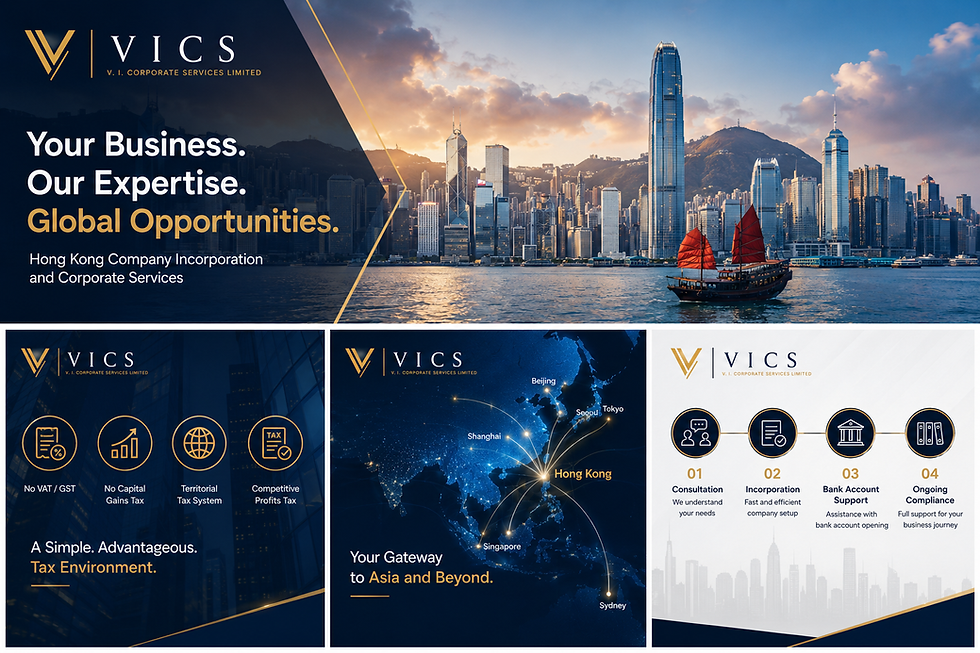
Simple and competitive tax regime
No VAT or GST
No capital gains tax
No withholding tax on dividends
Freely convertible currency
Strong legal system based on common law
World-class banking infrastructure
Direct access to Mainland China through various economic initiatives
For businesses trading internationally, Hong Kong continues to offer one of the most efficient corporate environments available.
Why Singapore Is Highly Regarded
Singapore has built its reputation on political stability, efficient government services, and a highly developed financial sector.
Advantages include:
Excellent infrastructure
Strong intellectual property protection
Extensive double taxation treaty network
Attractive incentives for technology, fintech, biotech, and regional headquarters
Highly respected regulatory framework
Strong reputation among multinational corporations
Singapore is often chosen by companies planning to establish a substantial regional operational presence.
Tax Comparison
One of the biggest considerations in the Hong Kong vs Singapore decision is taxation.
Hong Kong
Hong Kong applies a territorial tax system.
Generally, only profits arising in or derived from Hong Kong are subject to Profits Tax. Whether profits are taxable depends on the specific facts and circumstances and how the Inland Revenue Department determines the source of those profits.
Current Profits Tax rates are:
8.25% on the first HKD 2 million of assessable profits for eligible corporations under the two-tiered regime
16.5% on the remaining assessable profits
Hong Kong also does not impose:
VAT
GST
Capital gains tax
Dividend withholding tax
Singapore
Singapore's headline corporate income tax rate is 17%.
However, effective tax rates may be reduced through:
Start-up tax exemptions
Partial tax exemptions
Government incentive programs
Industry-specific schemes
Singapore also operates a territorial-style system, although certain foreign-sourced income may become taxable unless exemption conditions are met.
The tax system is more detailed than Hong Kong's but remains highly competitive globally.
Banking
Both jurisdictions offer excellent banking systems.
Hong Kong
Hong Kong remains one of Asia's largest international financial centres.
Businesses commonly access:
International commercial banks
Multi-currency accounts
Global payment services
Trade finance facilities
Cross-border RMB services
Hong Kong is particularly attractive for businesses with suppliers or customers in Mainland China.
Singapore
Singapore offers:
Strong fintech ecosystem
Leading international banks
Digital banking innovation
Regional treasury solutions
Excellent investment banking services
Singapore is particularly popular among venture-backed startups and regional headquarters.
Company Formation Requirements
Hong Kong
Requirements include:
At least one shareholder
At least one director (individual or corporate, subject to applicable rules)
Company secretary
Registered office in Hong Kong
There is no requirement for a resident director.
This makes Hong Kong particularly attractive for foreign entrepreneurs.
Singapore
Requirements include:
At least one shareholder
At least one resident director
Company secretary
Registered office
For foreign entrepreneurs without a local partner, appointing a resident director often involves using a nominee director service, increasing annual compliance costs.
Compliance Requirements
Both jurisdictions require annual compliance.
Hong Kong
Typical obligations include:
Annual Return filing
Business Registration renewal
Accounting records
Annual financial statements
Profits Tax Return filing (when issued)
Audit requirements generally apply, although the extent of reporting depends on the company's circumstances.
Singapore
Companies generally must maintain:
Accounting records
Annual financial statements
Annual Return filing
Corporate tax filings
Ongoing compliance with ACRA and IRAS requirements
The exact obligations depend on company size and applicable exemptions.
Which Jurisdiction Is Better for Different Businesses?
Choose Hong Kong if you:
Trade internationally
Source products from China
Operate an import/export business
Want lower ongoing compliance costs
Do not have a Singapore resident director
Need flexible ownership structures
Choose Singapore if you:
Plan to build a physical regional headquarters
Hire employees locally
Seek government incentive programs
Operate in technology or life sciences sectors
Need strong regional operational infrastructure
Cost Considerations
Initial incorporation costs in both jurisdictions are relatively competitive.
However, ongoing annual costs often differ because Singapore companies typically require:
Resident director arrangements (if applicable)
Additional compliance requirements
Potentially higher administrative costs
Hong Kong is often more cost-effective for international holding companies and trading businesses.
International Reputation
Both Hong Kong and Singapore enjoy strong international credibility.
Banks, investors, suppliers, and multinational corporations are familiar with companies incorporated in either jurisdiction.
The better choice depends less on reputation and more on your commercial objectives.
How VICS Can Help
At V. I. Corporate Services Limited (VICS), we assist entrepreneurs, investors, and international businesses with:
Hong Kong company incorporation
Corporate secretarial services
Registered office services
Ongoing compliance support
Business advisory
Assistance with corporate bank account applications
International corporate structuring
If you are deciding between Hong Kong vs Singapore, our team can help you evaluate which jurisdiction best aligns with your business model and long-term objectives.
Contact us today to discuss your expansion plans.
Frequently Asked Questions
Is Hong Kong cheaper than Singapore for company formation?
Yes, Hong Kong has lower ongoing costs because it does not require a resident director.
Is Hong Kong better for trading companies?
For many international trading businesses, particularly those dealing with Mainland China, Hong Kong offers significant practical advantages.
Can foreigners own 100% of a Hong Kong company?
Yes. Foreign individuals and companies may generally own 100% of a Hong Kong company.
Which jurisdiction has lower taxes?
Both offer competitive tax systems. Hong Kong generally has lower headline corporate tax rates and does not impose VAT or GST, while Singapore offers various tax exemptions and incentive programs that may reduce the effective tax burden for eligible businesses.
Conclusion
The Hong Kong vs Singapore comparison has no universal winner.
Hong Kong is often the preferred choice for international trading, holding companies, and businesses seeking simplicity, tax efficiency, and direct access to China.
Singapore excels for companies building regional operations, attracting investment, or benefiting from government incentive programs.
Before deciding, it is advisable to evaluate your expected business activities, compliance obligations, banking requirements, and long-term expansion plans.
With proper planning, either jurisdiction can provide an excellent foundation for international growth.
Should you wish to discuss both options, please contact us at HK@vics.com.hk. Our team will be pleased to help you determine which jurisdiction best suits your business needs.

Comments